

Validating Assured PNT with U.S Army by Sustaining 0.012% Accuracy Under GNSS Jamming
Share:
Published on:
Background
APEX – the U.S. Army’s (All-Domain Persistent Experiment), evaluates mission resilience across technologies including assured PNT, integrated sensing, advanced communications, data transport, and edge processing. Advanced Navigation has participated in this U.S. Army program for three years to challenge its systems under realistic Electromagnetic Warfare conditions.
Challenge
The modern battlefield is characterized by a DDIL (Degraded, Denied, Intermittent and Low-bandwidth) where adversaries actively deny, degrade, and spoof GNSS signals. Relying on a single navigation technology creates a mission-ending vulnerability. The challenge is to deliver reliable, high-accuracy, and unwavering PNT integrity, enabling decisive operations in a contested, multi-domain threat landscape where external signals are compromised.
Solution
Advanced Navigation successfully demonstrated its inertial-centric, intelligent navigation architecture, anchored by a resilient inertial core with complementary aiding sensors. The key components include:
- Boreas D90: A Fiber Optic Gyroscope Inertial Navigation System INS) that acts as the nervous system of the stack. It enables independent, high-confidence navigation without reliance on GNSS or magnetic compasses.
- AdNav Intelligence: Advanced Navigation’s adaptive software. It continuously validates all sensor inputs, dynamically weighs the input from each sensor based on reliability scores and environmental context, and autonomously counteracts spoofing and jamming.
- Chimera Land: A Laser Velocity Sensor (LVS) that enables uncompromised dead reckoning reliability, and built for operational theaters where GNSS is compromised or denied.
- Wheel Speed Encoder: An aiding source that measures wheel rotation to calculate vehicle speed, providing an INS with independent velocity updates to constrain accumulated drift.
Outcome
The deployment at APEX successfully validated Advanced Navigation’s technology as a reliable inertial-centric architecture for assured PNT on the modern battlefield.
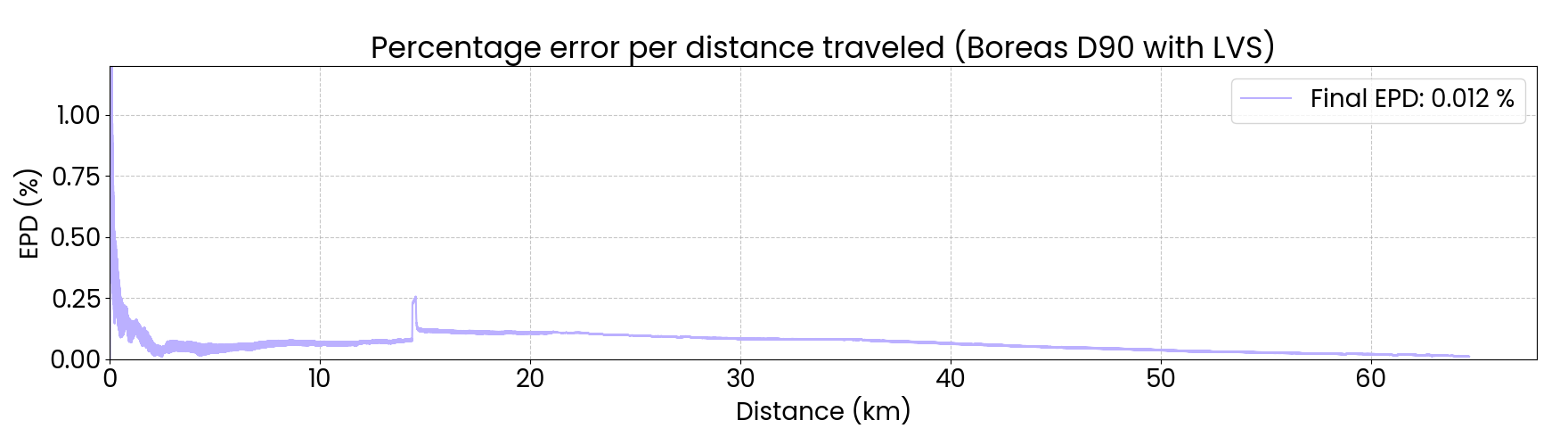
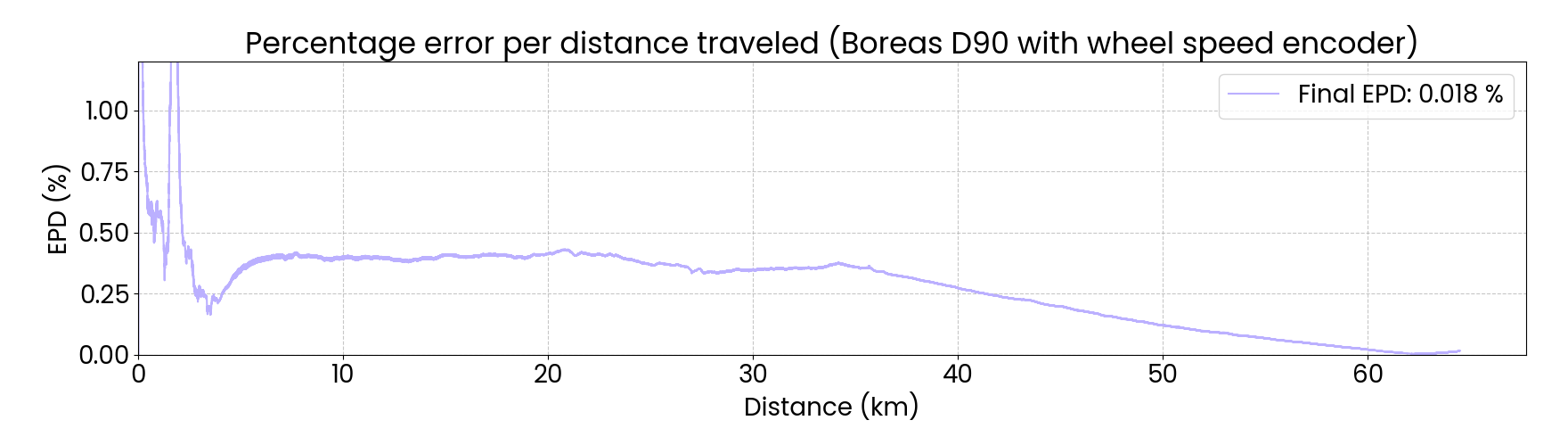
The demonstration was conducted during night operations at a site in rural New Mexico, USA, at which event organizers created an environment of complex and emerging Electromagnetic Warfare threats by conducting GNSS jamming, yielding the following dead-reckoning accuracy results over a 65 km route:
Boreas D90 + LVS: Achieved accuracy with a 0.012% error per distance traveled (7.5 m over 65 km).
| INS Aiding Source | Error at 20km | Peak error at approximately 40km travelled | Final error per distance travelled at 65km |
| Boreas + Laser Velocity Sensor | 25m | 26m | 0.012% |
Boreas D90 + Wheel Speed Encoder: Delivered reliable dead-reckoning performance with a 0.018% error per distance traveled (11.7 m over 65 km).
| INS Aiding Source | Error at 20km | Peak error at approximately 40km travelled | Final error per distance travelled at 65km |
| Boreas + wheel speed encoder | 88m | 112m | 0.018% |
These results reaffirm the intelligent, inertial-centric multi-sensor approach as a resilient foundation for assured PNT. The solutions demonstrate the operational reliability and accuracy required for successful navigation in GNSS-denied and -degraded conditions.
For more information about the full validation, read our technical article.