
Why Cost Effective All-Band GNSS/INS is Key to Operational Efficiency
Share:
Published on:
Article Summary
The Challenge: Loss of reliable, high-precision vehicle positioning on a mine site increases costs by undermining core systems such as auto-dispatching and material tracking, reducing overall efficiency.
The Solution: Advanced Navigation’s inertial navigation systems range will now utilize all-band GNSS technology, including L6/E6. This gives affordable access to not only all GNSS constellations and frequencies simultaneously, but the increasingly available, high-accuracy satellite-based services, which can significantly improve localization accuracy without further infrastructure.
The Outcome: Implementing an all-band GNSS solution maximizes asset visibility, leading to optimized dispatching and breaks vendor lock-in for a more efficient and cost-effective operation.
The relentless pressure to boost productivity without compromising on mining safety hinges on the Global Navigation Satellite System (GNSS).
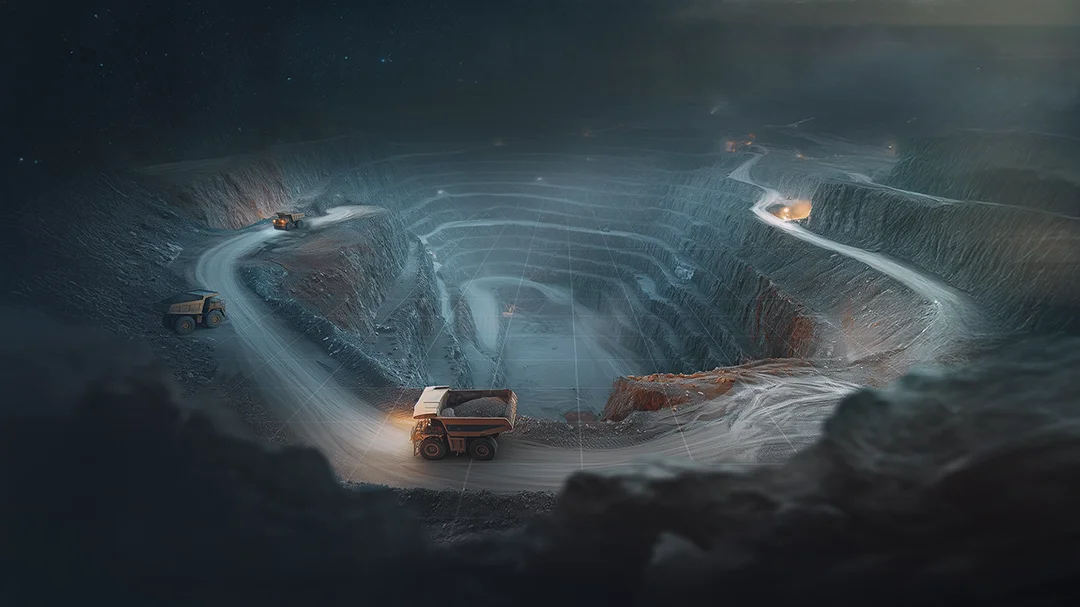
From autonomous haulage systems to high-precision machine guidance on excavators and dozers, most operations rely on a constant stream of accurate positioning data of their mobile assets.
Unreliable positioning, lost RTK lock, and intermittent data can prevent mobile equipment from operating efficiently, such as the accurate movement of autonomous haulers as they park under the dig unit. Inconsistent localization can also add to ambiguous positioning of vehicles, and therefore, material tracking which makes mine operations less efficient than it needs to be.
With the prevalence of GNSS-only, often tablet-based fleet management solutions or automatic dispatching solutions, their reliance on the older, but dominant dual-band (L1/L2) technology could be the limiting factor in achieving the next level of operational efficiency. This is because even with RTK corrections, the traditional approach for a cost-conscious FMS was to use dual-band GNSS receivers, however, these are proving to be a more fragile solution within the dynamics of a complex mine site. Given that all-band GNSS has previously been reserved to only the highest performance, survey-grade receivers, they were deemed not worth the cost of entry.
This is where the power of an all-band enabled GNSS/INS can be the key to delivering fleet management efficiency. By combining our existing, mature INS technology with the latest, yet cost effective all-band GNSS technology, operations can benefit from both improved GNSS performance, while also gaining access to the much needed vehicle motion and orientation information in real-time.
What All-Band Means for Mining
For years, the industry standard has been dual-band receivers, primarily using the L1 and L2 frequencies from the GPS constellation, and over time, the additional frequencies of other constellations. With each increase in the number of signals available, there have been substantial, but diminishing performance improvements.
However, the unsung hero of adding more frequencies and constellations is the added benefit of consistency and the reliability of RTK, meaning ultimate RTK accuracies are available more often and take less time to acquire from a cold start.
And now, with cost-effective access to both all-band and signal modernizations, such as L6 and E6, accuracies that rival prior generations of RTK-based configurations can be achieved with nothing but a clear sky – no subscriptions or base stations necessary.
This increased availability and reliability provides a log of where every single truck was loaded and unloaded, giving material traceability, which is vital for tracking ore grades, and therefore, how much of each was ultimately crushed and sent to a given stockpile or processing plant with higher certainty.
Upgrading Your Fleet With All-Band
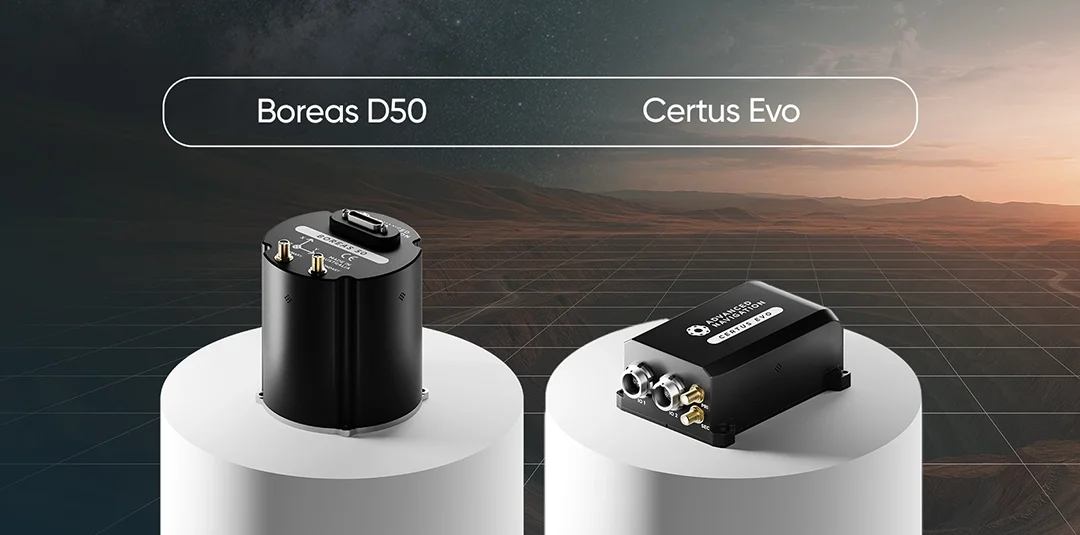
Advanced Navigation offers a scalable range of products with all-band GNSS receivers to maximize your fleet mining equipment efficiency:
Certus Evo
Certus Evo is our compact MEMS INS that is ideal for a wide range of mining vehicles. Though an exceptional choice for autonomy, Certus Evo is also highly relevant for high precision machine guidance where crewed excavators and front loaders must interact with autonomous vehicles.
Certus Evo also comes with a low size, weight, power and cost (SWaP-C) profile, ensuring ease of integration and retrofitting with minimal vehicle downtime for installation, without costly modifications, making the benefits of all-band GNSS accessible across your entire fleet, autonomous or otherwise.
Boreas D50
For the most demanding mining applications such as autonomous haulage in especially difficult environments, where real-time kinematics (RTK) is likely to fail well before GNSS interruptions, the all-band GNSS receiver is also available in the Boreas D50 FOG INS.
By offering highly reliable north-seeking and dead-reckoning performance, even during a complete GNSS outage, your assets maintain precise navigation for far more useful periods of time.
The Future of Surface Navigation is INS with All-Band
Ultimately, a cost-effective all-band GNSS/INS turns your fleet’s position data from a liability in “grey areas” into your most reliable asset for driving fleet efficiency.
Ready to see how all-band GNSS can transform your fleet mining equipment efficiency? Contact our mining specialists to discuss a solution tailored for your operation.
FAQs
I already have dual-band GNSS. Why do I need all-band?
Dual-band is good in open skies, but it can struggle on a mine site near buildings or pit walls where signals bounce, causing your RTK to drop. All-band sees more signals, so it has a much higher probability of rejecting those “bounced” signals and holding its high-precision lock.
What happens when my vehicles lose RTK cell coverage at the edge of the site?
A standard receiver’s accuracy will drop to several meters, rendering your data inaccurate. An all-band receiver uses satellite-based correction signals (E6/L6) as a high-accuracy fallback, so your mining vehicle’s position remains reliable and accurate even when comms are lost.
Recent Tech Articles

Choosing the Right Navigation for Autonomy in Mining
Discover how Advanced Navigation’s Certus and Certus Evo GNSS/INS solutions improve fleet management and scale autonomy in mining.
29 September 2026
Go to Article
Surviving GNSS Denial: Free Inertial vs. Dead Reckoning Navigation
Learn what dead reckoning is in navigation and how it compares to free inertial mode for UGVs and UAVs operating during prolonged GNSS outages.
14 September 2026
Go to Article