
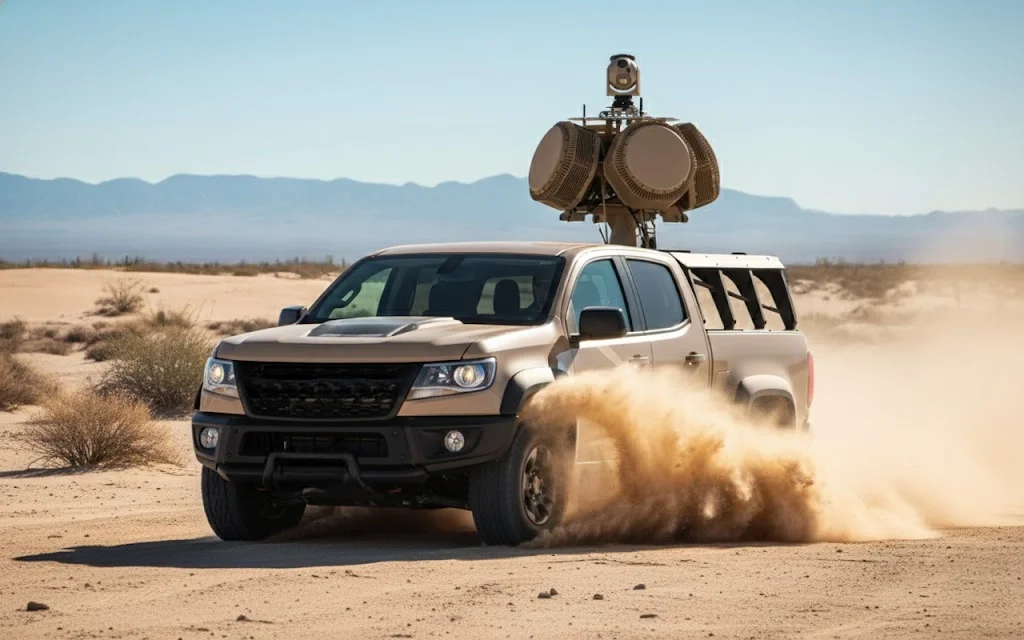
How C-UAS Platforms Maintain Heading and Positioning in GNSS-Denied Environments
Share:
Published on:
Article Summary
The Challenge: As organizations migrate C-UAS platforms to commercial vehicles for speed and cost efficiency, these platforms still expose heading and positioning vulnerabilities in GNSS-denied environments where traditional magnetic and satellite compasses fail.
The Solution: Advanced Navigation provides a scalable hierarchy of inertial solutions to deliver positioning and heading accuracy to C-UAS platforms and optimized performance-to-value ratios for a range of mission profiles.
The Outcome: Successfully deploy low SWaP-C, high-precision capabilities on agile commercial vehicles, while avoiding the technical risks of GNSS dependence and the financial inefficiency of over-specified hardware.
The rapid adoption of Commercial Off-The-Shelf (COTS) vehicles for Counter-UAS (C-UAS) missions is reshaping mobile defense vehicles.
By mounting sophisticated effectors onto non-military vehicles, integrators can deploy C-UAS platforms faster and with greater logistical flexibility.
However, this shift introduces some familiar challenges. Regardless of the type of vehicle, the C-UAS still depends on an accurate heading and position to perform, and thus requires a high performance navigation system with a low SWaP-C.
Legacy navigation solutions for C-UAS have struggled with ease of integration, ongoing maintenance and SWaP, while traditional defense-grade INS solutions are often over-engineered and prohibitively large to integrate.
To bridge this gap, integrators need to find reliable navigation systems that can prioritize resilient heading in GNSS-denied environments and deliver scalable performance hierarchies.
Don’t Let Jamming Blind Your Fleet
Achieve Assured PNT with Electronic Protection that outpaces the threat. Download our report to see how our Electronic Protection can de-risk your next defense program.
Download the report

Heading Accuracy for C-UAS in Denied Environments
In modern theaters today, GNSS jamming and spoofing are no longer edge cases, but rather have become the baseline operating conditions.
For a C-UAS platform, heading is vital.
If the system cannot accurately orient its radar or optical sensors, it cannot accurately track or interdict a target.
Relying on a dual-antenna GNSS for heading is a single point of failure that adversaries will exploit immediately. Furthermore, magnetic compasses are rendered unreliable by the ferrous interference of the vehicle itself and the mounted equipment.
Advanced Navigation addresses this with both the Certus Evo Inertial Navigation System (INS) and Boreas D50 Fiber-Optic Gyroscope (FOG) INS, both of which defend your C-UAS from electromagnetic warfare.
While no system is infinitely immune to all forms of electronic attack, our navigation solutions are capable of resisting the specific vulnerability of RF jamming, and retaining an accurate heading solution long enough to complete its mission, even under a sustained barrage of GNSS denial.
Boreas D50 Inertial Solution
For high-value C-UAS assets where a reliable heading is essential, the Boreas D50 offers north-seeking resilience in a compact form factor.
Unlike magnetometer-based solutions, the D50 does not require satellite visibility or a clean magnetic environment to find north. It enables a C-UAS vehicle to maintain a precise heading lock purely through Earth rotation sensing.
It provides the capability required to resist a jamming event and extends the platform’s operational window in denied environments, ensuring the mission can be executed before heading drift impacts tracking accuracy.
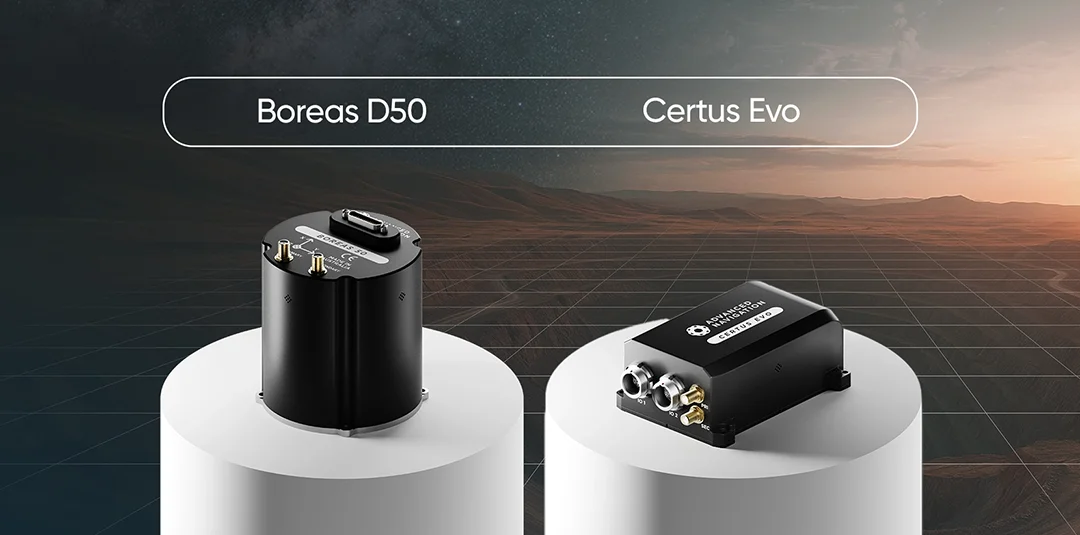
Certus Evo Inertial Solution
For lighter, swarming, or highly mobile units, the Certus Evo delivers near-FOG accuracy in a package that is significantly lighter and power-efficient. It utilizes dual-antenna GNSS for initial alignment, and its AdNav Intelligence sensor fusion allows it to retain positional and directional accuracy through jamming events with exceptional accuracy.
Featuring an industry-leading SWaP-C, Certus Evo is an ideal choice for light patrol vehicles, drone-on-drone interceptors, and fleets where cost-per-unit scalability is the driving metric.
Scalability for the Mission
The primary driver for using COTS vehicles for C-UAS is efficiency.
More and more integrators are moving away from “one-size-fits-all” military procurements toward agile, mission-specific configurations.
Similarly, the navigation stack must offer the same flexibility.
Advanced Navigation supports this modularity through a performance hierarchy that allows integrators to align the sensor precisely with the mission profile and budget efficiency.
Closing the Gap
A C-UAS deployed on a COTS vehicle in a contested zone faces the same electromagnetic warfare vulnerabilities as a main battle tank.
Advanced Navigation empowers organizations to deliver the necessary accuracy required for deploying a C-UAS on a commercial vehicle, without breaking the unit economics that made the COTS approach viable in the first place.
In the era of asymmetric warfare, the winning systems will not necessarily be the most expensive, but rather will be the ones that remain operational when the spectrum goes dark.
Contact our defense team to discuss your specific platform constraints and define the right resilience strategy.
FAQs
How does the Boreas D50 maintain accurate heading when GNSS signals are jammed or spoofed?
The Boreas D50 utilizes FOG technology to sense the rotation of the Earth, allowing it to determine its heading without relying on satellite signals or magnetic references. Moreover, the D50 can come with an electronic protection variant that includes dual multi-band GNSS receivers, with the additional functionality to make the D50 resilient to jamming and spoofing.
Can I integrate both the Boreas D50 and Certus Evo into the same fleet architecture?
Yes, both systems share a unified communication protocol, allowing you to scale performance across your fleet without rewriting your software stack. You can deploy the Boreas D50 on strategic nodes for maximum resilience and the Certus Evo on tactical units to optimize for cost and weight.
Does Advanced Navigation offer integration support for C-UAS platforms?
Advanced Navigation offers highly responsive integration support, designed to ensure an optimal performance of our INS on C-UAS platforms. While our INS products are built for ease of integration, we do offer additional services for more complex deployments should the need arise.
Recent Tech Articles

Choosing the Right Navigation for Autonomy in Mining
Discover how Advanced Navigation’s Certus and Certus Evo GNSS/INS solutions improve fleet management and scale autonomy in mining.
29 September 2026
Go to Article
Surviving GNSS Denial: Free Inertial vs. Dead Reckoning Navigation
Learn what dead reckoning is in navigation and how it compares to free inertial mode for UGVs and UAVs operating during prolonged GNSS outages.
14 September 2026
Go to Article