
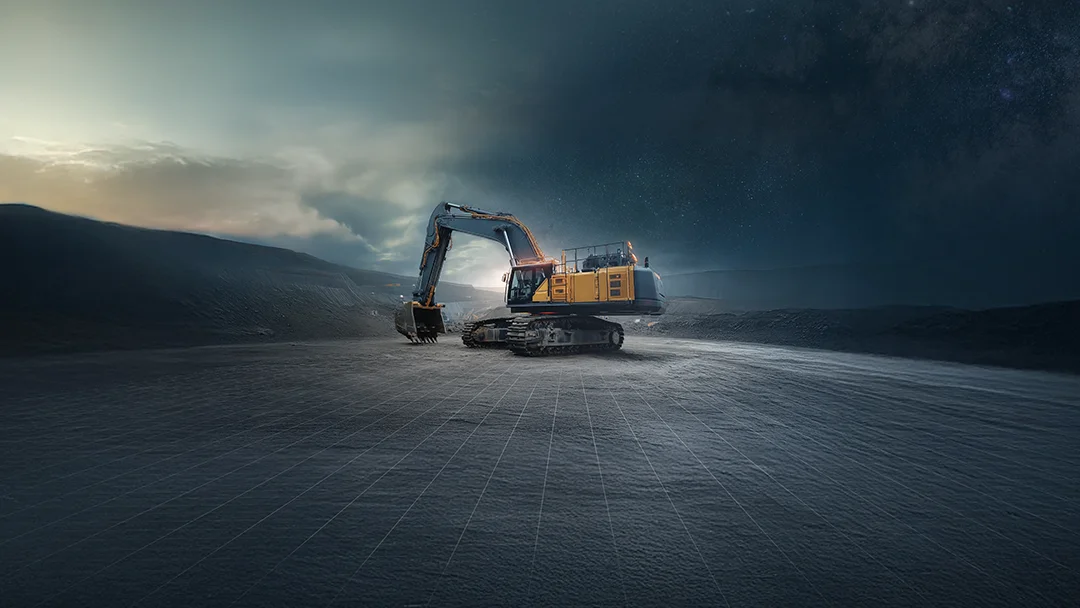
How Improved Positional Accuracy Can Transform Mining Excavation
Share:
Published on:
Article Summary
The Challenge: In mining environments, GNSS multipath causes errors in excavator positioning, leading to ambiguous muckpile management, ore quality dilution, or worse still, interruptions to autonomous haulage.
The Solution: Advanced Navigation’s Inertial Navigation Systems fused with its Chimera Land Laser Velocity Sensor (LVS) can mitigate navigational drift over extended periods of time by anchoring the positioning system to real ground motion.
The Outcome: This validated technology solution reduces positional blind spots so dig units recover the material that was planned, improving overall muckpile management, and avoid unnecessary interruptions to haulage. The resulting improvements to cycle time efficiency and reduced ore quality dilution helps maximise extraction yields.
Modern mining relies heavily on sophisticated data ecosystems. With the increasing adoption of higher-resolution ore quality maps and fully Autonomous Haulage Systems (AHS), the success of these multi-million-dollar, data-driven solutions remain predicated almost entirely on accurate positioning.
As surface mining operations develop deeper and deeper pits, the risk of more extreme GNSS interruptions increases, such that high-precision machine guidance becomes an uphill battle. Satellite visibility drops, signals bounce unpredictably off sheer rock walls, and traditional GNSS positioning quickly degrades. The resulting GNSS environment reduces GNSS reliability, and can create blind spots within the pit, presenting a significant challenge to managing the muck pile efficiently. Until now, this has been an ongoing, unsolved problem in the mining industry, where the existing “solutions” are more of a band-aid, rather than a robust cure.
However, proven navigation technologies are finally bridging this gap, offering a long duration solution that anchors machine positioning to reality, even when satellite data fails.
Why Traditional Stopgaps Fall Short
Historically, mine managers have had to rely on a patchwork of fallbacks when GNSS begins to wander. While some turn to purely inertial systems or try to filter out the multipath errors algorithmically, the extreme GNSS conditions of deeper pits often overwhelms these mostly software-based mitigation attempts.
Other tactics depend on LiDAR and vision systems to try and maintain spatial awareness. While these technologies are excellent for object detection and short-range mapping, they are not designed to be primary, standalone absolute positioning systems in harsh, dusty, and visually uniform environments that are constantly changing, leaving the perception system with nothing to anchor against. They are essentially stopgap measures—ways to just “get by” rather than true solutions tailored for the rigors of an excavation made for mining. What the industry actually requires is a dedicated mechanism that mitigates navigational drift over extended periods of time.
Anchoring Real Motion
To counteract GNSS interruptions and INS positional drift, the navigation solution needs an additional ground truth. If the satellite signals are bouncing, then the raw GNSS position starts wandering, requiring an independent, highly accurate way to verify whether the machine is actually moving, and at what speed and in which direction.
This is where Advanced Navigation’s Chimera Land Laser Velocity Sensor (LVS) changes the paradigm.
The Chimera Land LVS is an advanced optical sensor designed specifically for rugged ground vehicles. It continuously measures the exact speed and direction of the vehicle relative to the ground beneath it using laser precision. By feeding accurate velocity data into the navigation filter, LVS provides a continuous reference to real motion.
The Power Pairing of an INS + LVS
It is vital to note that the Chimera Land LVS is not a standalone positioning system; it is a highly specialized velocity aiding sensor, designed specifically to unlock the value of Advanced Navigation’s Inertial Navigation Systems (INS).
Advanced Navigation offers tailored pairings to suit the performance requirements or the severity of the environment:
- For standard deep pit operations, pairing the Certus Evo INS with the Chimera Land LVS creates a robust, highly accurate positioning suite that substantially resists drift, maintaining practical utility even as GNSS degrades.
- For the deepest mine pits, where satellite denial is prolonged and multipath can be more extreme, pairing the Boreas D50 with the Chimera Land LVS provides a reliable navigation safety net.
In both configurations, the INS + LVS combo delivers continuous, high-precision machine guidance, with very low drift compared with any similar system before it. The LVS actively negates the amount of GNSS wandering that plagues the INS in deeper pits, ensuring that every movement made by the machine is being measured, instead of the system being dominated by sensor errors.
The Callio Mine Benchmark
Advanced Navigation’s INS + LVS system was validated by BHP in Europe’s deepest underground mine, where the system traversed a round trip of over a 6,008 meters (6km), demonstrating a final error of just 0.55 meters, or 0.009% of the total distance traveled. To put that into perspective, over a 6-kilometer run, the machine’s reported position drifted by merely half a meter.
Read the technical deep dive here.
Maximizing Yield and Operational Flow
For a dig unit navigating the tricky depths of a pit without reliable satellite data, this level of precision bridges the gap between an ambiguous location and an optimized load cycle, allowing operations to continue for many minutes, if not hours, without stable GNSS.
The availability of stable, low-drift localisation, allows the excavator to align with the shift plan or the ore quality model much more closely, ensuring only the targeted material is moved or loaded. This has the potential to improve muck-pile management, better leverage ore-quality mapping to reduce dilution rates, and speed up post-shift reconciliation.
Furthermore autonomous trucks can more reliably and confidently move into the ideal position near the dig unit, requiring fewer corrections to position the truck in range of the bucket if the location of both vehicles is known more accurately. By minimizing repositioning efforts, cycle times can be reduced, leading to improved haulage throughput.
Explore Advanced Navigation’s comprehensive navigation solutions for the mining sector and speak to one of our experts today to find the perfect INS + LVS configuration for your site.
FAQs
How does the Chimera Land Laser Velocity Sensor mitigate the navigational drift caused by poor satellite visibility?
The Chimera Land Laser Velocity Sensor uses precision lasers to continuously measure the dig unit’s actual speed and direction directly from the ground beneath it. With access to such highly accurate velocity data, the INS can separate real motion from erratic GNSS multipath data, physically anchoring the machine’s reported position to reality.
How does resolving this positional ambiguity impact our AHS fleet?
When the excavator’s exact location is stabilized by the Inertial Navigation System + laser velocity sensor, autonomous haul trucks can more efficiently navigate to the loading position, even when conditions are less than ideal.
Recent Tech Articles

Choosing the Right Navigation for Autonomy in Mining
Discover how Advanced Navigation’s Certus and Certus Evo GNSS/INS solutions improve fleet management and scale autonomy in mining.
29 September 2026
Go to Article
Surviving GNSS Denial: Free Inertial vs. Dead Reckoning Navigation
Learn what dead reckoning is in navigation and how it compares to free inertial mode for UGVs and UAVs operating during prolonged GNSS outages.
14 September 2026
Go to Article